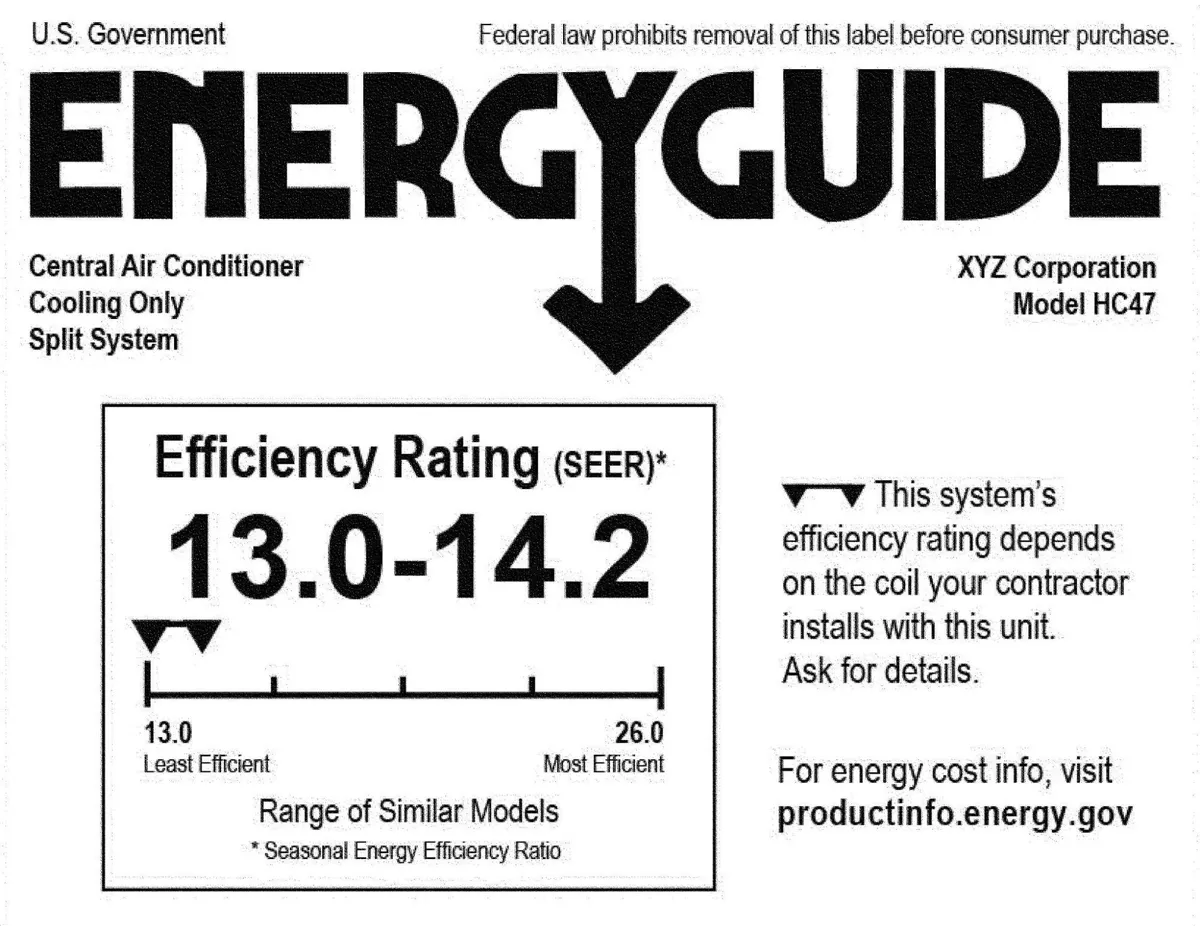
If you’ve ever shopped for a new air conditioner in Mesa, you’ve probably seen those yellow EnergyGuide labels plastered with numbers like 16 SEER or 20 SEER and wondered what on earth it all means. We get that question constantly from homeowners and business owners alike—especially when the triple-digit heat rolls in and the electric bill feels like a second mortgage. The truth is, understanding SEER can be the difference between an AC unit that quietly keeps you comfortable and one that runs your meter into the ground.
What Exactly Is a SEER Rating (and Why Should You Care)?
SEER stands for Seasonal Energy Efficiency Ratio. Think of it like miles-per-gallon for your car, except instead of measuring how far you go on a tank of gas, it measures how much cooling you get for every watt of electricity your air conditioner uses over an entire summer.
Here’s the simple version: the higher the SEER number, the less electricity your AC needs to keep the house at 75 degrees when it’s 115 outside. That translates directly to lower SRP or APS bills—which, let’s be honest, feels pretty great in July.
You know what? A lot of folks still have old 10 or 12 SEER units from the early 2000s chugging along. They work…sort of. But they’re basically guzzling power the way a muscle car guzzles premium. Swap that for something modern and the savings add up fast.
How SEER and the Newer SEER2 Ratings Work
Let me explain the math without making your eyes glaze over. SEER is calculated by taking the total cooling output (in BTUs) your AC provides during a typical cooling season and dividing it by the total electricity it uses (in watt-hours). The test assumes a mix of hot, mild, and cooler days—pretty much like a real Arizona summer.
In 2023 the Department of Energy updated the testing procedure to better mimic real-home conditions (higher duct pressure, etc.). The new numbers are called SEER2 and run about 4–7% lower than the old SEER ratings for the same equipment.[1] So a unit that used to be labeled 16 SEER might now be 15.2 SEER2. Same machine—just more honest testing.
Why the change? Because the old lab conditions were a little too kind. The new ones reflect what actually happens once the system is installed in your attic with real ductwork.
Current Minimum SEER Requirements (Especially Here in Arizona)
Arizona falls into the DOE’s “Southwest” region, so the rules are a bit stricter than up north. As of 2023:
| System Type | Minimum SEER2 (Southwest) |
|---|---|
| Split-system air conditioners (<45k BTU) | 15.2 SEER2 (roughly 16 old SEER) |
| Split-system heat pumps | 14.3 SEER2 (roughly 15 old SEER) |
| Packaged units | 13.4 SEER2 |
Anything manufactured before January 2023 can still be installed if it met the old rules, but pretty much everything on the market now meets or beats the new minimums.[2]
Does a Higher SEER Really Save You Money in Mesa?
Absolutely—especially here. We run our air conditioners hard from April through October. The difference between a base-model 15.2 SEER2 unit and a solid 18–20 SEER2 system can easily be $200–$400 a year on a typical 2,500 sq ft Mesa home.
Here’s a quick real-world example we see all the time:
- Older 10–12 SEER unit → around $450–$550 per month at peak summer
- New 16 SEER2 system → drops that to $300–$380
- 20 SEER2 variable-speed → often under $280 (and the house feels cooler and less humid)
That might sound odd, but the higher-rated systems use variable-speed compressors that ramp up and down gently instead of slamming on and off. They run longer at lower speeds, wring more humidity out of the air, and waste way less energy.
Common SEER Ratings You’ll See Today
Here’s what’s actually available in 2025:
- 14–15 SEER2 – Builder-grade, cheapest upfront, still way better than old units
- 16–18 SEER2 – Sweet spot for most Mesa homeowners; great balance of cost and savings
- 19–22+ SEER2 – Premium variable-speed systems; quiet, ultra-efficient, perfect for larger homes or anyone who hates high bills
Fun fact: some of the Trane and Carrier models we install hit 22 SEER2 and qualify for nice federal tax credits too.
Other Factors That Affect Your Real Efficiency
SEER is important, but it’s not the only thing. You can take the highest-SEER unit on the planet and turn it into a power hog if:
- Ducts are leaky or poorly insulated (common in older Mesa homes)
- The system is oversized or undersized
- Thermostat is old or poorly placed
- No regular tune-ups
That’s why we always do a proper load calculation and check the whole system—not just swap the outdoor unit and call it a day.
So…What SEER Should You Aim For in a New AC Unit?
Honestly? If you’re replacing a failed 10–13 SEER system in Mesa, anything 16 SEER2 or higher will feel like a revelation. Most of our customers land in the 17–19 range—enough efficiency to see serious savings without breaking the bank on the install.
Business owners with bigger square footage or 24/7 cooling needs usually go 19+ because the payback is even faster.
Ready for a Cooler, Cheaper Summer?
We’ve been helping Mesa-area homeowners and businesses beat the heat for years, and we’d love to figure out exactly what SEER (and overall system) makes the most sense for your place. Give us a call at 480-207-1239 or schedule online—we’ll walk through the numbers together and find something that keeps you comfortable without the sticker shock on your power bill.
Sources
- U.S. Department of Energy – Central Air Conditioning energy.gov
- U.S. Department of Energy – New Efficiency Standards (2023) energy.gov